Step 1
Copy of one side of DNA strand is made (called mRNA, messenger RNA)
A
|
Biology
|
|
|
introduction
Biology is the study of complicated things that have the appearance of having been designed with a purpose.Every time I hear a politician mention the word 'stimulus,' my mind flashes back to high school biology class, when I touched battery wires to a dead frog to make it twitch. |
|
|
entries
profile
tagboard
linkage
sample answer
|
|
|
- Friday, 18 March 2016 @ 23:18
Translation
In translation, mRNA is sent to the cytoplasm, where it
bonds with ribosomes, the sites of protein synthesis. Ribosomes
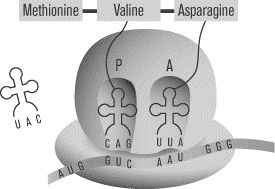
have three important binding sites: one for mRNA and two for tRNA.
The two tRNA sites are labeled the A site and P site.
![]()
Once the mRNA is in place, tRNA molecules, each associated
with specific amino acids, bind to the ribosome in a sequence defined
by the mRNA code. tRNA molecules can perform this function because
of their special structure. tRNA is made up of many nucleotides
that bend into the shape of a cloverleaf. At its tail end, tRNA
has an acceptor stem that attaches to a specific amino acid. At
its head, tRNA has three nucleotides that make up an anticodon.
![]()
An anticodon pairs complementary nitrogenous bases with
mRNA. For example if mRNA has a codon AUC, it will pair with tRNA’s
anticodon sequence UAG. tRNA molecules with the same anticodon sequence
will always carry the same amino acids, ensuring the consistency
of the proteins coded for in DNA.
The Process of Translation
Translation begins with the binding of the mRNA
chain to the ribosome. The first codon, which is always the start
codon methionine, fills the P site and the second codon fills the
A site. The tRNA molecule whose anticodon is complementary to the
mRNA forms a temporary base pair with the mRNA in the A site. A
peptide bond is formed between the amino acid attached to the tRNA
in the A site and the methionine in the P site.
![]()
The ribosome now slides down the mRNA, so that the tRNA
in the A site moves over to the P site, and a new codon fills the
A site. (One way to remember this is that the A site brings new
amino acids to the growing polypeptide at the P site.) The appropriate
tRNA carrying the appropriate amino acid pairs bases with this new
codon in the A site. A peptide bond is formed between the two adjacent
amino acids held by tRNA molecules, forming the first two links
of a chain.
![]()
The ribosome slides again. The tRNA that was in the P
site is let go into the cytoplasm, where it will eventually bind
with another amino acid. Another tRNA comes to bind with the new
codon in the A site, and a peptide bond is formed between the new
amino acid to the growing peptide chain.
![]()
The process continues until one of the three
stop codons enters the A site. At that point, the protein chain
connected to the tRNA in the P site is released. Translation is
complete.
|
|
|
TRANSCRIPTION - @ 23:08
![]() Transcription
The first step in transcription is the partial unwinding
of the DNA molecule so that the portion of DNA that codes for the
needed protein can be transcribed. Once the DNA molecule is unwound
at the correct location, an enzyme called RNA polymerase helps line up
nucleotides to create a complementary strand of mRNA.
Since mRNA is a single-stranded molecule, only one of the two strands
of DNA is used as a template for the new RNA strand.
![]()
The new strand of RNA is made according to the rules of
base pairing:
For example, the mRNA complement to the DNA sequence TTGCAC
is AACGUG. The SAT II Biology frequently asks about the sequence
of mRNA that will be produced from a given sequence of DNA. For
these questions, don’t forget that RNA uses uracil in place of thymine.
After transcription, the new RNA strand is released and
the two unzipped DNA strands bind together again to form the double
helix. Because the DNA template remains unchanged after transcription,
it is possible to transcribe another identical molecule of RNA immediately
after the first one is complete. A single gene on a DNA strand can
produce enough RNA to make thousands of copies of the same protein
in a very short time.
|
|
|
- @ 22:46
THREE ROLES OF RNA IN PROTEIN SYNTHESIS
|
|
|
Step of protein synthesis - Monday, 14 March 2016 @ 19:08
Step 1
Copy of one side of DNA strand is made (called mRNA, messenger RNA)
Step 2
mRNA moves to cytoplasm, then ribosome
Step 3
mRNA goes through ribosome 3 bases at a time
Step 4
transfer RNA (tRNA) matches up with the open DNA bases
Step 5
tRNA releases the amino acid at the top, which joins the chain of amino acids being produced
|
|
|
- @ 18:51
what is protein synthesis
All cell function through their protein. Protein function is define by their molecular function , localization within cell and involvement in a particular biological process. All components of protein function are defined by the exact composition, structure and conformation of the proteins, which is encrypted within the DNA region (called locus) encoding that protein. With the process of protein synthesis biological cells generate new proteins, which on the other hand is balanced by the loss of cellular proteins via degradation or export.
Transcription is the first of overall two protein synthesis steps. During transcription, the information encoded in the DNA is copied to a RNA molecule as one strand of the DNA double helix is used as a template. The RNA molecule is sent to the cytoplasm, which helps to bring all components required for the actual protein synthesis together – amino acids, transport RNAs, ribosomes, etc. In the cytoplasm the protein polymers are actually “synthesized” through chemical reactions – that is why the process is known as “protein synthesis” or even more precisely – “protein biosynthesis”.
The RNA copy of the protein genetic information encoded in DNA molecule is produced in the nucleus and it is called messenger RNA (mRNA). Each mRNA encodes the information for a single protein and is much smaller in size compared to the DNA molecule. This makes possible for mRNA molecules to exit the nucleus through tiny openings called nuclear pores. Once it exits the nucleus and enters the cytoplasm, the mRNA could interact with a cellular structure known as a ribosome, which serves as the cell’s assembler within the process of protein synthesis. The ribosome consists of proteins and ribosome RNA molecules (rRNA), which are organized in two subunits. The mRNA initially binds to just one of the ribosome sub-units.
When the mRNA interacts with the big ribosome sub-unit, this triggers the approach of another RNA molecule, called transfer RNA (tRNA). The tRNA molecule possess a specific sequence of 3-bases (anti-codon), which hast to complement a corresponding sequence (codon) within the mRNA sequence. When it finds it, it attaches to the mRNA, as the other end of the tRNA is “loaded” with an amino acid. At this point arrives the other sub-unit of the ribosome and a complete structure is formed. The first tRNA binds to a so called “start codon”, which is one and the same for all proteins. As the complete ribosome structure is formed, another tRNA molecule approaches. The next tRNA differ from the first one and is carrying another amino acid. Again, the tRNA must have an anti-codon that matches complementary the second codon of the mRNA. The two amino acids carried by the first two tRNAs are bind together with help from the ribosome and using cellular energy in the form of adenosine triphosphate (ATP).
The above steps repeats until there are uncoupled codon sequences on the mRNA – thus the chain of amino acids grows longer. Once the sequence of amino acids is successfully assembled in a protein, the two ribosome sub-units separate from each other, to be joined again for later use.
The actual sequence of amino acids forms the so called primary structure of the proteins. Depending on the exact composition and order of the amino acids in the protein sequence, the chain folds into a three-dimensional shape. When this happens the protein is complete.
The process of protein synthesis takes place in multiple ribosomes simultaneous and all throughout the cell cytoplasm. A living cell can synthesize hundreds of different proteins every single second.
|
|
|
profile
![]() |
|
|
tagboard
|
|
|
linkage
Previous Months: March 2016 ;
|
|