

Translation
In translation, mRNA is sent to the cytoplasm, where it
bonds with ribosomes, the sites of protein synthesis. Ribosomes
have three important binding sites: one for mRNA and two for tRNA.
The two tRNA sites are labeled the A site and P site.

Once the mRNA is in place, tRNA molecules, each associated
with specific amino acids, bind to the ribosome in a sequence defined
by the mRNA code. tRNA molecules can perform this function because
of their special structure. tRNA is made up of many nucleotides
that bend into the shape of a cloverleaf. At its tail end, tRNA
has an acceptor stem that attaches to a specific amino acid. At
its head, tRNA has three nucleotides that make up an anticodon.

An anticodon pairs complementary nitrogenous bases with
mRNA. For example if mRNA has a codon AUC, it will pair with tRNA’s
anticodon sequence UAG. tRNA molecules with the same anticodon sequence
will always carry the same amino acids, ensuring the consistency
of the proteins coded for in DNA.
The Process of Translation
Translation begins with the binding of the mRNA
chain to the ribosome. The first codon, which is always the start
codon methionine, fills the P site and the second codon fills the
A site. The tRNA molecule whose anticodon is complementary to the
mRNA forms a temporary base pair with the mRNA in the A site. A
peptide bond is formed between the amino acid attached to the tRNA
in the A site and the methionine in the P site.

The ribosome now slides down the mRNA, so that the tRNA
in the A site moves over to the P site, and a new codon fills the
A site. (One way to remember this is that the A site brings new
amino acids to the growing polypeptide at the P site.) The appropriate
tRNA carrying the appropriate amino acid pairs bases with this new
codon in the A site. A peptide bond is formed between the two adjacent
amino acids held by tRNA molecules, forming the first two links
of a chain.
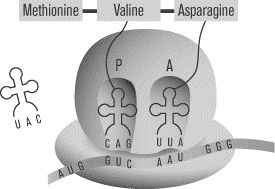
The ribosome slides again. The tRNA that was in the P
site is let go into the cytoplasm, where it will eventually bind
with another amino acid. Another tRNA comes to bind with the new
codon in the A site, and a peptide bond is formed between the new
amino acid to the growing peptide chain.

The process continues until one of the three
stop codons enters the A site. At that point, the protein chain
connected to the tRNA in the P site is released. Translation is
complete.


